Are you a drone inspection service?
AeriScout lists 364 drone inspection services. A free listing gives you a profile page and quote requests from people looking for drone inspection near you, sent straight to your inbox.
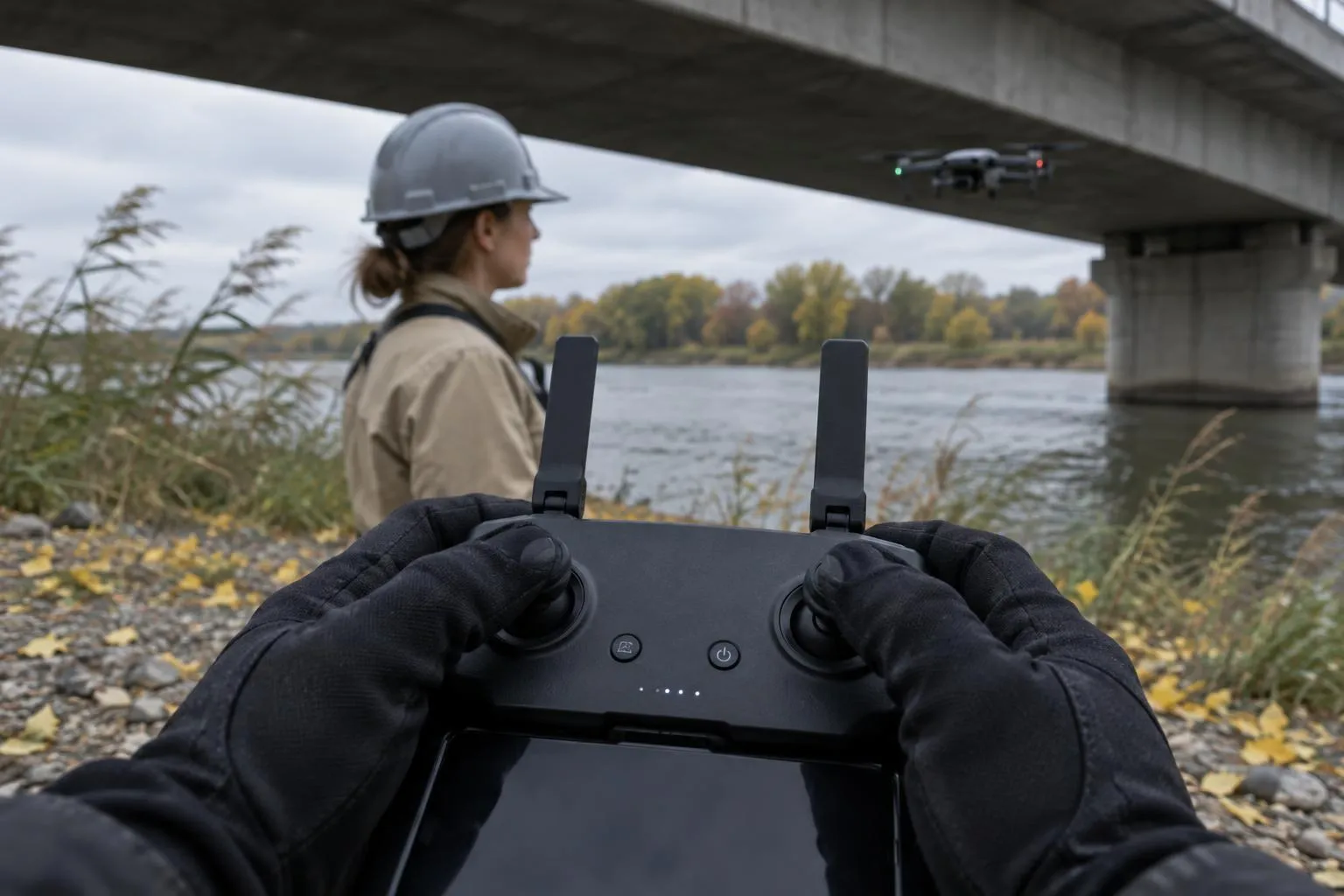
A few months back, I watched a contractor spend three days on scaffolding inspecting a bridge deck — two guys, hard hats, safety lines, thermal camera on a pole. The report came back a week later. Meanwhile, a drone operator I know did the same job in four hours. Same bridge, same defects found. The contractor’s client paid roughly three times more.
That gap is only going to widen. And it’s made a lot of drone inspection professionals nervous.
The Short Version:AI won’t replace drone inspection pilots anytime soon — but it will replace the ones who refuse to use it. The technology automates defect detection and flight planning. It still can’t exercise judgment, carry liability, or adapt to conditions on the ground. The pilot’s job is changing, not disappearing.
Key Takeaways:
- AI-powered defect detection now hits 95%+ accuracy — outperforming manual visual review on repetitive tasks
- Automated drone operations cut inspection costs by 50–60%, primarily through labor reduction
- The skills that survive automation: client judgment, adaptive flying, regulatory compliance, and liability acceptance
- The drone inspection pilots most at risk aren’t being replaced by AI — they’re being replaced by other pilots who use AI
What AI Actually Does Well
Nobody tells you this part clearly, so here it is: AI is genuinely excellent at the boring, high-volume stuff.
Run a pre-programmed flight path over a 500-panel solar array. Capture thermal and RGB imagery at consistent altitude. Flag every panel with a temperature variance above threshold. Output a geotagged report with severity scores. That workflow — end to end — is fully automatable today. FlyNex and similar platforms are doing it at scale, with up to 60% lower costs than traditional inspection crews.
The computer vision piece is legitimately impressive. Deep learning models trained on crack propagation, corrosion patterns, and structural misalignment can detect defects that human reviewers miss — subtle surface fractures, early-stage delamination, micro-corrosion on transmission hardware. We’re talking 95%+ accuracy on controlled defect classification tasks. That’s not marketing copy; that’s what the research on these systems actually shows.
For oil and gas pipeline inspections, AI anomaly detection running on BVLOS (Beyond Visual Line of Sight) drone platforms can surveil thousands of miles of infrastructure with minimal human intervention. The drone-in-a-box model — where aircraft live in weatherproof stations and fly autonomously on schedule — is already operational in some sectors.
The honest summary of what AI automates well: Anything repetitive, high-volume, and visually classifiable. Flight path execution. Defect flagging against a known taxonomy. Report generation. Scheduling based on predictive maintenance models.
What It Doesn’t Do Well
Here’s what most people miss when they’re either panicking or hand-waving about AI.
| Task | AI Capability | Human Required? |
|---|---|---|
| Pre-programmed flight over known structure | High | No (with proper setup) |
| Defect detection against trained taxonomy | High (95%+) | Review only |
| Adapting to unexpected site conditions | Low | Yes |
| Regulatory compliance / airspace decisions | None | Yes |
| Client communication and scope management | None | Yes |
| Novel structure types (no training data) | Low | Yes |
| Accepting legal and professional liability | None | Yes |
| Thermal anomaly interpretation in context | Moderate | Often yes |
| Post-storm emergency response (variable scene) | Low | Yes |
The AI can tell you there’s a temperature differential on panel 247. It can’t tell you whether that’s a failing bypass diode, a soiling pattern from bird droppings, or an artifact from how the sun hit the array at 2:17 PM. Context judgment — the “so what does this mean for the asset owner” question — still belongs to the human.
Reality Check:The drone-in-a-box, fully autonomous inspection model works great on assets with known geometry and stable environments. It struggles with post-storm roof assessments where debris patterns are unpredictable, construction sites where the scene changes weekly, or any job where the client is asking “is this safe to use?” rather than “find defects.”
The Hybrid Architecture Nobody Talks About
The most sophisticated current deployments don’t use AI instead of human judgment — they use what practitioners call a hybrid architecture: deterministic computer vision for precise detection and measurement, layered with generative AI for contextual reasoning and report narrative. Microsoft’s Azure industrial inspection framework documents this explicitly.
The workflow looks like this: drone captures imagery → CV model classifies and localizes defects → generative AI synthesizes findings into a coherent report with maintenance priority recommendations → human inspector reviews and signs off.
That last step matters more than most people admit. Insurers, infrastructure owners, and regulatory bodies want a licensed professional’s signature on inspection reports. A Part 107 certificate and professional liability insurance aren’t things you can automate. They’re the reason your client calls you instead of just buying drone-in-a-box software.
Pro Tip:If you’re a drone inspection pilot, the smartest move right now is to get fluent in the AI platforms your clients’ industries are adopting — DroneDeploy, Skydio, Percepto, whatever’s dominant in your niche. The operators who get squeezed out won’t be replaced by robots; they’ll be replaced by competitors who output the same deliverables in half the time using AI-assisted workflows.
The Jobs That Actually Disappear
I’ll be honest about what’s at risk: low-complexity, high-volume visual inspection work that follows a predictable template. Routine solar array thermal scans. Scheduled transmission tower surveys on known infrastructure. Repetitive construction progress documentation on standard site layouts.
These jobs don’t disappear — the revenue compresses. AI-assisted pilots do them faster, which means lower billable hours per job and more competitive pricing pressure. The pilot who built a business on “I’ll spend two days flying your solar farm” is in trouble. The one who built it on “I’ll turn around a fully analyzed thermal report with maintenance recommendations by tomorrow morning” is not.
The jobs that expand: emergency response, complex industrial facilities, novel structures, anything requiring regulatory coordination, litigation support, and — importantly — managing the AI systems themselves. Someone has to train the defect detection models on your client’s specific asset types. That someone is going to be a pilot who understands both the physical inspection domain and the data pipeline.
Practical Bottom Line
AI is changing drone inspection services the same way GPS changed surveying. It didn’t eliminate surveyors — it raised the bar for what a competent surveyor delivers, and it eliminated the jobs that were purely about showing up and collecting data without adding interpretation.
The drone inspection pilots who thrive over the next five years will use AI to cut their turnaround times and deliver richer reports. They’ll compete on judgment, liability acceptance, and client relationships — not on whether they can spot a crack manually.
Three things worth doing now:
- Get trained on at least one AI-assisted inspection platform relevant to your primary niche (solar, utilities, roofing, infrastructure — pick one)
- Build your service deliverables around the analysis and recommendations, not just the raw imagery — that’s where AI augments rather than replaces
- Read the Complete Guide to Drone Inspection Services if you want context on how the broader market is structured and where inspection niches are growing
The question isn’t whether AI will change your job. It already has.
Done reading? Get quotes from drone inspection services near you.
Takes about a minute. Free, no obligation; providers reply to you directly.
Popular cities:
Nick built this directory to help general contractors and risk managers find FAA Part 107-certified drone inspectors without wading through generalist photography outfits that added a drone as an upsell — a conflict of interest he ran into when trying to document storm damage on a commercial roof and couldn’t tell which operators carried the commercial liability insurance to back their reports.