Get free quotes from drone inspection near you
Takes about a minute. Free, no obligation; providers reply to you directly.
A contractor friend called me last year, furious. He’d hired a drone service off the first Google result to inspect a commercial roof before closing on a warehouse. The report came back in 48 hours — four photos and two paragraphs. No thermal imaging. No coverage percentage. No PE stamp. His inspector flagged three HVAC units with moisture damage the drone crew had flown right over. The “inspection” cost $400. The repair bill was $38,000.
The drone came back fine. The service was junk.
The Short Version:A legitimate commercial drone inspection runs $2,500–$12,000 and includes FAA Part 107 certification, $1M+ liability insurance, PE-stamped reports, and AI-assisted defect analysis. Any quote under $1,000 for a commercial project is almost certainly missing at least one of those. Get three quotes, compare deliverables — not price.
Key Takeaways:
- FAA Part 107 certification and PE-certified reports are non-negotiable for commercial work
- Coverage guarantees of 90–100% separate serious providers from hobbyists
- Enterprise-grade drones (RTK GPS, radiometric thermal) achieve ±2–4mm accuracy — consumer drones cannot
- Turnaround should be days, not weeks; if they say 3–4 weeks, keep looking
The Lie the Industry Tells You
Most drone inspection guides talk about drones. How many megapixels. Which brand. Whether they fly fixed-wing or multi-rotor.
Here’s what most people miss: the drone is the least important part of the decision.
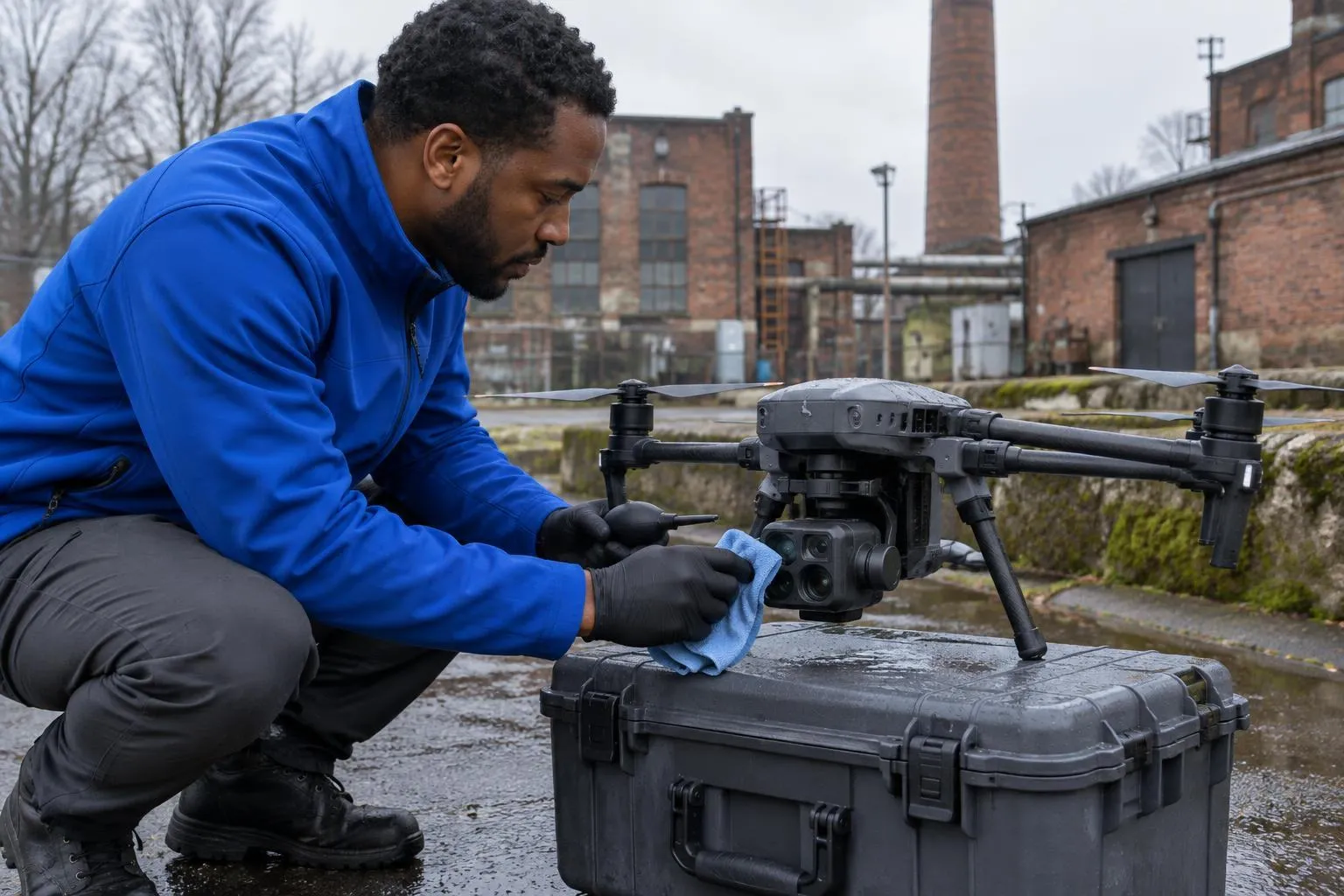
What you’re actually buying is the pilot’s certifications, the sensor package, the data processing pipeline, and the report that lands on your desk. A $15,000 DJI Matrice piloted by someone who bought their Part 107 cert and has never inspected a commercial building is worth less than a mid-range drone flown by a team with verified industry experience and a PE-stamped deliverable.
Nobody tells you this because the drone is the sexy part. The report is not.
The 8 Questions to Ask Before You Hire Anyone
These are the questions that separate providers in five minutes. Get answers in writing.
- Can you provide your FAA Part 107 Remote Pilot Certificate? — Not optional. This is the legal baseline for commercial UAV operation. If they hesitate, hang up.
- Do you carry liability insurance, and will you provide a Certificate of Insurance? — Minimum $1M; prefer $5M+ for commercial sites. COI should name your company.
- What cameras and sensors will you use on this project? — You want 20MP+ RGB cameras, radiometric FLIR thermal sensors for moisture/heat anomalies, and RTK GPS for positional accuracy. Consumer drones have none of this.
- Will the final report be PE-certified? — For any building inspection, a Professional Engineer stamp is mandatory for the report to hold weight with insurers, lenders, or regulators.
- What percentage of the structure will be covered? — The answer should be 90–100%. “We’ll do our best” is not a coverage guarantee.
- How is defect detection handled — AI, manual review, or both? — Best-in-class providers use AI classification followed by human QA. Manual-only is slower and more error-prone.
- What is your typical turnaround time? — Days, not weeks. If they say 3–4 weeks for a standard commercial inspection, that’s a process problem.
- Can you share a sample report and two references from similar projects? — This one filters out 80% of the bad actors instantly. Legitimate providers have these ready.
Red Flags vs. Green Flags
| Criteria | Red Flag | Green Flag |
|---|---|---|
| Pricing (commercial) | Under $1,000 | $4,000–$12,000 with deliverables |
| Certification | No Part 107, no PE reports | Part 107 + PE-stamped reports |
| Insurance | Declined to share COI | $5M+ liability, COI on request |
| Equipment | Consumer drone, no thermal | 50MP+ cameras, FLIR, RTK GPS |
| Coverage | ”We’ll cover most of it” | 90–100% written guarantee |
| Reports | Raw photos, no analysis | AI-annotated, defect severity ratings |
| Turnaround | 3–4 weeks | 24–72 hours |
| References | None available | Same-industry referrals ready |
Reality Check:A quote under $1,000 for a commercial building inspection is not a deal — it’s a sign the provider is skipping PE certification, proper sensor packages, or AI analysis. The $400 inspection and the $8,000 inspection are not the same product with different margins. They are categorically different services.
Certified vs. Uncertified: What Actually Changes
FAA Part 107 isn’t just a box to check. Certified pilots understand controlled airspace, NOTAM requirements, weather minimums, and safe distance protocols around structures. They file the right paperwork before flying near airports or towers. They know when not to fly.
Uncertified operators — and there are plenty offering services online — create liability exposure for you, not just themselves. If an uncertified pilot crashes into your facility or violates airspace restrictions on your property, the legal exposure lands everywhere.
Beyond the pilot, PE certification on reports is what transforms a photo collection into a document that can influence underwriting decisions, construction bids, or regulatory filings. A report without a PE stamp is an opinion. A PE-stamped report is a professional assessment.
Pro Tip:Ask specifically whether the company owns its drone fleet or rents equipment per project. Providers who own their equipment — enterprise DJI Matrice series with FLIR and RTK — have standardized workflows and quality control. Rental-fleet operators often show up with whatever was available that week.
The Accuracy Question Nobody Asks
Survey-grade drone inspections using RTK GPS achieve positional accuracy of ±2–4mm. That’s the difference between “there’s a crack near the northeast corner” and “there’s a 3mm crack at exactly these coordinates, here’s the defect map, here’s its severity rating.”
For infrastructure work — transmission lines, bridges, cell towers, solar arrays — that precision matters. SkySpecs completes automated wind turbine blade inspections in 15 minutes per turbine. The data isn’t approximate. The geometry is exact.
I’ll be honest: if a provider can’t tell you their accuracy specification and what GPS system they’re using, they’re probably not delivering the kind of data that justifies the inspection cost. Enterprise-grade accuracy is the whole point.
Practical Bottom Line
Get at least three quotes. Ask all eight questions above for each. Throw out any commercial quote under $1,000 immediately. For anything involving a building, require a PE-certified report — not optional.
Before the inspection, give your provider a complete site brief: flag towers, overhead wires, proximity to airports, any restricted areas. Good providers will ask for this anyway. Bad ones won’t.
Request a sample report before signing anything. If the sample report is four photos and a paragraph, that’s exactly what you’ll get.
For a full breakdown of what drone inspection services cover, how they’re used across industries, and what to expect from the data deliverables, read The Complete Guide to Drone Inspection Services.
The drone is the easy part. The provider behind it is the whole game.
Done reading? Get quotes from drone inspection services near you.
Takes about a minute. Free, no obligation; providers reply to you directly.
Popular cities:
Nick built this directory to help general contractors and risk managers find FAA Part 107-certified drone inspectors without wading through generalist photography outfits that added a drone as an upsell — a conflict of interest he ran into when trying to document storm damage on a commercial roof and couldn’t tell which operators carried the commercial liability insurance to back their reports.